Hospital Class or Private Newborn Class: Which Do You Need?
Take the hospital class. Then take a private one, or don't, depending on what you still want to know.
That is the honest answer, and it is not a dodge. They are built to answer different questions, and most families need both answers.
First, these are three different things
This trips up more people than anything else here, and the labels do not help.
A childbirth class prepares you for labor and delivery. Stages of labor, pain management, interventions, C-sections, what happens in the room.
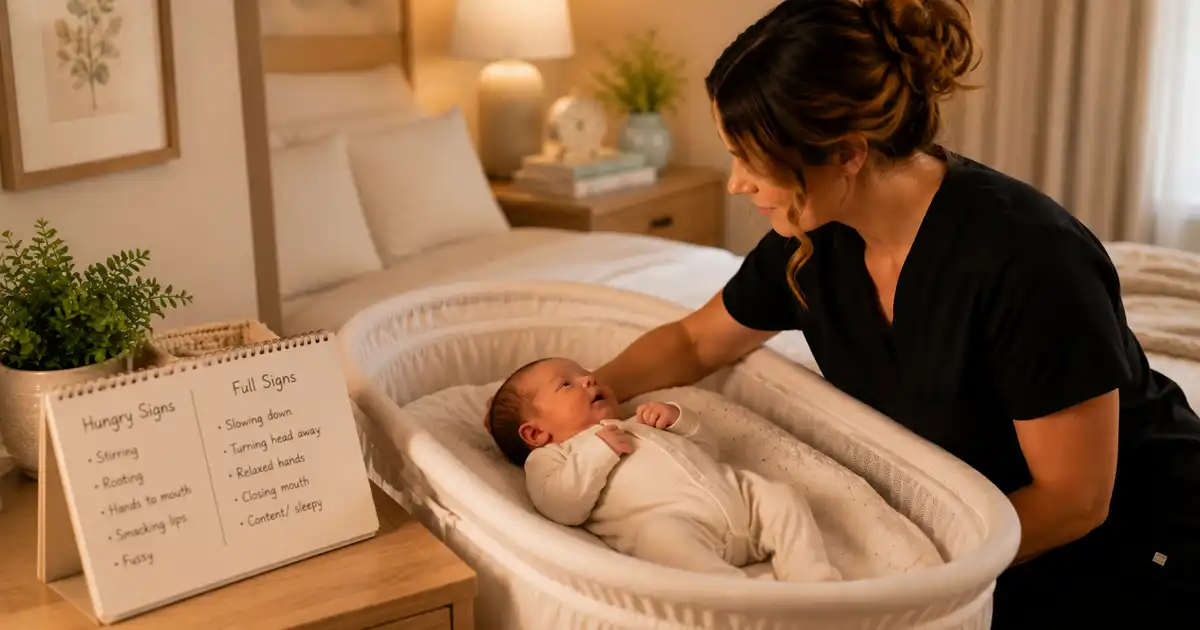
A newborn care class prepares you for the baby. Feeding, sleep, diapering, bathing, soothing, what is normal, when to call someone. Things like reading hunger and fullness cues, which take about four minutes to explain and change every feed afterward.
A breastfeeding class is a third thing again, usually taught by a lactation consultant.
Plenty of people take a childbirth class, tick the box, and arrive home with a newborn having had roughly forty minutes on newborn care in week thirty-two. The birth is a day. The part afterward is the rest of your life, and it gets a fraction of the preparation.
Are hospital classes worth it? Yes, take one
Genuinely. They are inexpensive, often free if you are delivering there, taught by nurses, and evidence-based. If you are choosing between a hospital class and nothing, take the hospital class.
What only your hospital can tell you
This is the part no other class can replicate, and it is the strongest reason to go.
Where to park at 2am. Which entrance is open. When to call and when to just come. What happens at check-in. Visitor policies. Where the recovery rooms are. What their lactation support looks like. What happens to your baby in the first hour.
A private class, a book, and a course made in another state cannot answer any of that. Your hospital can.
What it does for a partner
Worth booking for this alone.
Pregnant parents tend to arrive having read a great deal. Partners often have not, and a class gives them a structured version of what is coming, what their job is, and what to expect afterward, without either of you having to manufacture that conversation.
Is Lamaze still a thing?
Yes, though far fewer classes are strictly Lamaze now. Most hospital childbirth classes today are a general preparation curriculum drawing on several approaches rather than one method.
Worth asking what philosophy a class is built on before you book. Some are built around a specific approach to birth, and if that does not match what you want, the class will feel like it is arguing with you.
Where the group format runs out
None of this makes hospital classes bad. It makes them a particular shape.
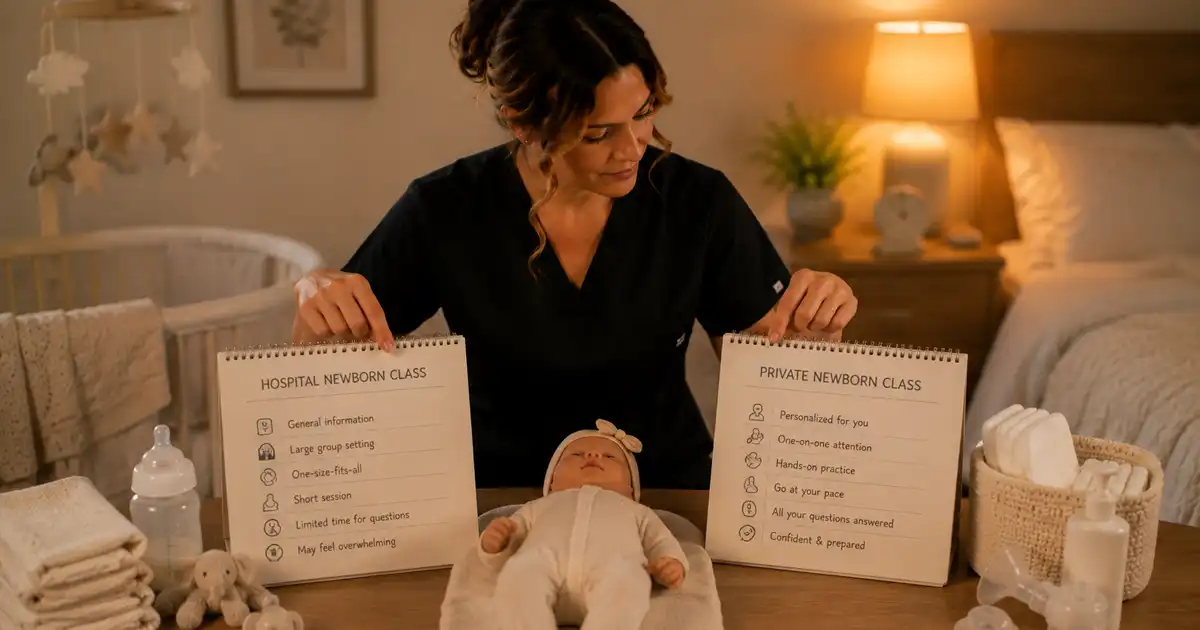
You practice on a doll. Every hospital class I have seen teaches swaddling and diapering on a doll, because there is no alternative in a room of twelve couples. Dolls do not squirm, arch their back, or scream while you are trying to get the third corner of the swaddle in.
It happens before the birth. Usually somewhere between 28 and 36 weeks, which is exactly when you do not yet know what you are going to find difficult. The questions arrive in week two.
One instructor, a fixed agenda, and a room of people. Your specific question about your specific situation gets a minute, if the schedule allows.
Your house is not in the room. Nobody can look at your bassinet, your bottles, your nursery, or the layout that means you are carrying a baby down a flight of stairs at 3am.
What a private newborn class is
Smaller, usually one family, and built around what you actually want to cover. In your home, or virtually.
The curriculum is not fixed, which is the point. Some families spend most of it on feeding. Others want safe sleep applied to the room they have. Others want to practice bathing and cord care on a baby who exists. Some want a grandparent in the room so everyone hears the same guidance at the same time.
Our private newborn classes are taught by a pediatric RN or nurse practitioner, and you tell us what to cover before we arrive.
Side by side
| Hospital class | Private class | |
|---|---|---|
| Your hospital's policies and layout | Strong | No |
| Labor and delivery | Strong | Usually not covered |
| Preparing a partner for the birth | Strong | Sometimes |
| Hands-on with your own baby | No | Yes, if booked after |
| Your nursery and your equipment | No | Yes |
| Time for your specific questions | Limited | The whole point |
| Grandparents and other caregivers | Rare | Yes |
| Cost | Low or free | Higher |
That last row matters and it is why the recommendation below is what it is.
Who benefits most from a private class
- Neither of you has looked after a newborn before. No amount of reading substitutes for someone watching you hold a baby and adjusting your arm
- You took the hospital class and still feel unready. Common, and not a failure of either of you
- You are already home and stuck. This is the case a hospital class structurally cannot serve, because you cannot attend one in week two
- Twins, or a baby home from the NICU. Different enough that a general class covers little of it, and preemie care has its own set of questions
- A grandparent or nanny will be doing a lot of the care. Guidance has changed considerably in a generation, particularly around safe sleep, and hearing it together avoids the argument
- You are going back to work soon and want bottles and pumping sorted before you do
What about online classes?
Useful, cheaper, and you can rewatch a section at 3am when you have forgotten how to do the swaddle. For a lot of families that is enough.
The honest limitations: nobody corrects your technique, nobody answers your particular question, the information may not match your hospital, and it is very easy to watch passively and absorb nothing. Watching someone swaddle is not the same as swaddling.
The recommendation: do both
Not a compromise. It is the sequence that actually works.
The hospital class in your third trimester, for the birth, the building, and getting your partner up to speed.
A private class either just before the birth or in the first weeks after, for the baby. We teach both, and if you are unsure which, book it after. A class with a real baby in the room is a different experience from a class with a doll, and by then you will know exactly what you want to ask.
Some families do a short session before and a longer one after. That works too.
Do you actually need a class?
No. People have raised babies without one for a very long time, and you will work most of it out.
What a class buys you is doing less of that learning while exhausted, recovering, and holding a baby for the first time. Whether that is worth it depends on how much newborn experience is already in your house, and how much help you have nearby.
If the answer to both is "not much", it is worth considering.
What to remember
- Childbirth class, newborn class, and breastfeeding class are three different things
- Take the hospital class. Nothing else can tell you about your hospital
- Group classes practice on dolls, before the birth, on a fixed agenda
- A private class is built around your questions, your house, and your baby
- The case a hospital class cannot serve is the one where you are already home
- Most families are best served by both, in that order
Before you book anything
- Which class is this: childbirth, newborn care, or breastfeeding?
- How many families will be in the room?
- Is there hands-on practice, and on what?
- Will my partner get anything specific to their role?
- Does it include a tour of where I am delivering?
- Who teaches it, and what is their background?
- How much time is set aside for questions?
- Is it before the birth only, or can I book after?
- Can grandparents or other caregivers attend?
- Does it cover safe sleep to current AAP guidance?
- Will I leave with anything written?
- What happens if I go into labor before the class date?
The last question catches more people than you would expect. A class scheduled at 38 weeks is a class you may never attend.
Common questions
What is the difference between a hospital class and a private newborn class?
A childbirth class prepares you for the day. A newborn class prepares you for the six weeks afterward. They answer different questions, and most families need both answers.
Is a hospital newborn class enough?
It is a good start and it is usually free or included. Where the format runs out is hands-on practice and your own specific questions, because a room of twenty couples cannot adjust your hands.
Do I need a private class if this is not my first baby?
Plenty of second-time families book one, usually for something specific: a different feeding plan, a preemie, twins, or how the first weeks will run with an older child.
When should we take a newborn class?
Late in the third trimester is common, so it is fresh. After the baby arrives also works, and often the questions are sharper because they are real by then.
Read the video transcript
People ask me whether the hospital class is enough, and my answer is that it depends what you are asking it to do.
Take the hospital class. Really. It is cheap or free, it is taught by nurses, and there is one thing it does that nothing else can: it tells you about your hospital. Where to park at two in the morning. Which entrance is open. When to call and when to just come. No online course and no private class can tell you that.
It is also genuinely good for partners, who often arrive having done a lot less reading than the person who is pregnant.
Where it runs out is the newborn part. You are practicing on a doll, in a room with twelve other couples, somewhere around 32 weeks. And dolls do not squirm, or arch their back, or scream while you are trying to get the third corner of the swaddle in.
The other thing is timing. You take that class before the birth, which is exactly when you do not yet know what you are going to find hard. The real questions turn up in week two.
So what I would actually suggest is both. Hospital class in the third trimester for the birth. Private class either just before, or in the first weeks after, for the baby.
And if you are not sure which, book it after. A class with a real baby in the room is a completely different thing from a class with a doll, and by then you will know exactly what you want to ask.