
Pumping Schedule for Going Back to Work
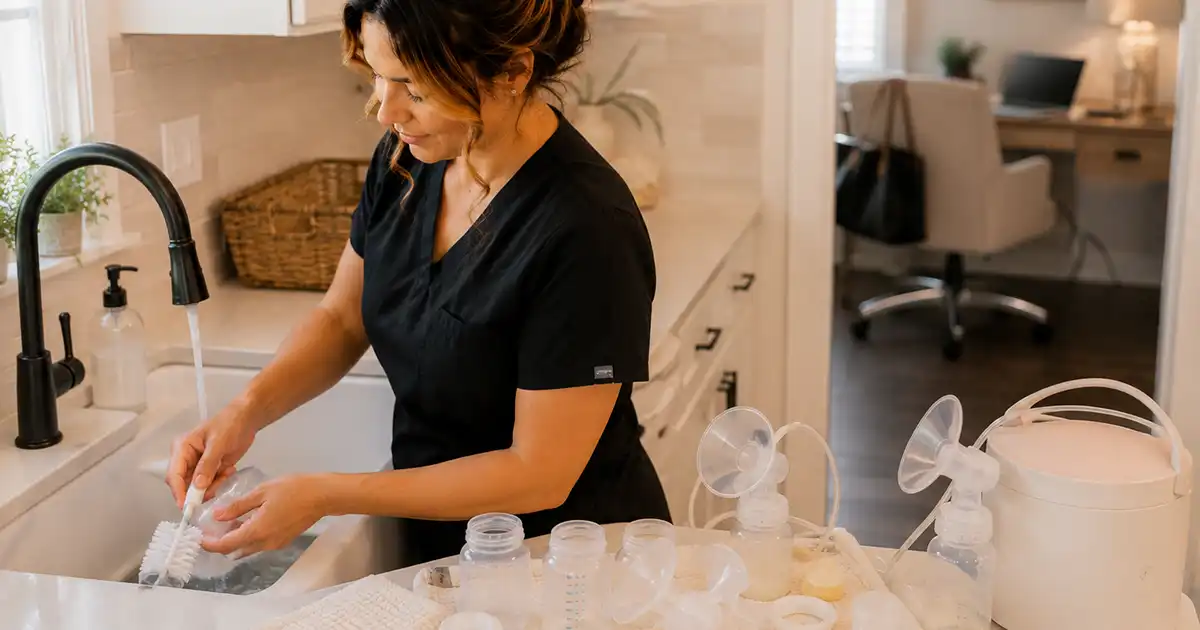
Pump about as often as your baby would normally feed while you are apart.
That is the principle every workable schedule is built on, and it is more useful than any specific timetable, because your baby's pattern is the thing that decides it.
The one rule underneath
Current CDC guidance is straightforward: when you are away from your baby, aim to pump roughly as often as they would normally drink breast milk.
So the math is not about hours at work. It is about how many feeds you are missing. If your baby feeds three times in the stretch you are away, you are aiming for around three sessions. If it is two, two.
That also means the schedule changes as your baby does. What works at three months is often not what you need at seven, and adjusting is normal rather than a sign something is wrong.
What a real workday looks like
Most people end up with some version of this:
Feed at the breast before you leave. As close to walking out the door as you can manage.
Pump at roughly even intervals across the day. For a standard workday that is commonly two or three sessions, often landing around mid-morning, lunchtime, and mid-afternoon.
Feed at the breast again at pickup, or as soon as you are home.
The shape matters more than the exact clock times. Evenly spaced beats perfectly timed, and a session that happens at 9:40 because a meeting overran is worth far more than one that gets skipped because it was not 9:30.
Longer shifts, night shifts and split shifts all work on the same principle. Count the feeds you are missing, not the hours.
Start practicing weeks before
This is the advice most people wish they had taken.
CDC recommends practicing before you go back rather than making your first workday the first real attempt, and it is right for reasons that have nothing to do with your supply.
You will find out how long a session actually takes you. Which is rarely what the pump manual suggests.
Your baby gets used to a bottle, ideally from someone else, before the day it becomes compulsory. Bottle refusal is much easier to solve in week two of practicing than on the morning of your first day back.
And you learn what your output looks like at the times you will actually be pumping, which is a very different thing from a relaxed Sunday morning session.
Start a few weeks out. Two or three practice sessions a week is plenty.
How much milk to leave
Roughly what your baby normally takes while you are gone. Which sounds unhelpfully vague until you realise the alternative is a number that is wrong for most babies.
Your caregiver can tell you what they actually used after the first few days, and that is far better information than any calculation. Send a little more than you think for the first week and adjust from there.
Two things that help more than getting the amount right:
Paced bottle feeding. A bottle that goes down in three minutes empties your freezer faster than one your baby actually controls. Pacing it is the single most useful thing your caregiver can do.
And asking them not to finish a bottle by force. If your baby stops, the feed is over, even with milk left.
You need a smaller stash than you think
The freezer stash is the most over-engineered part of this, and it causes enormous unnecessary stress.
For most people, what you pump today feeds your baby tomorrow. The stash is a buffer for the bad days, not the supply itself. A few days' worth is a comfortable cushion for most families.
Building an enormous freezer store before you go back is not necessary, and chasing one in the last weeks of leave is a reliable way to make yourself miserable during the part you should be enjoying.
Label everything with the date, use the oldest first, and follow current CDC storage guidance for how long milk keeps in the fridge, the freezer, and at room temperature.
Your right to break time and a private space
Worth knowing, because a lot of people do not.
Federal law requires most employers to provide reasonable break time to express milk, and a private space that is not a bathroom, for up to a year after birth. State law may add to that.
Practically: tell your manager in writing before you return, agree the times, and get the space confirmed rather than assuming. It is a much easier conversation in advance than on your first morning with a pump bag in your hand.
If a workplace is being difficult about it, the US Department of Labor is the place to look for what your specific rights are.
When a session gets missed
It will happen. A meeting overruns, a room is occupied, a shift goes badly.
Pump when you can, even if it is short and even if it is late. A ten-minute session is worth more than a skipped one.
Do not stack two missed sessions into one long one and assume that covers it. Frequency matters more than duration.
And if it is happening repeatedly, that is a scheduling problem to solve at work rather than something to absorb, because that is the pattern most likely to affect production over time.
If your supply changes
Some drop in output after returning to work is common, and there are a lot of reasons for it that have nothing to do with you doing something wrong: stress, less frequent removal, a different pump, dehydration, and simply being busier.
What I would do is speak to an IBCLC before making changes, rather than after. Supply questions depend on your history, your baby's age, your pump, and what you actually want to happen, and generic advice is not much use.
If what you want is to combine pumping with some formula, that is a completely normal outcome and combination feeding is its own decision rather than a failure of this one.
The first week is the worst one
Almost everybody finds the first week back harder than expected, and almost everybody finds week three considerably easier.
The logistics get quicker. You stop thinking about it. Your baby settles into the new pattern. Whatever you are feeling in the first few days is not a prediction of how this goes.
When to call someone
An IBCLC for supply changes, pain while pumping, flange fit, or output that has dropped noticeably.
Your pediatrician if your baby is not taking bottles well, seems unsettled by the change, or if you have questions about how much they are getting.
Your employer, in writing, if break time or space is not being provided.
What to remember
- Pump about as often as your baby would normally feed while you are away
- Count the feeds you are missing, not the hours you are working
- Practise a few weeks before, with your baby taking a bottle from someone else
- Leave roughly what your baby takes, then adjust from what your caregiver reports
- Your stash is a buffer, not the supply. A few days' worth is plenty
- Federal law gives you break time and a private space that is not a bathroom
- A short late session beats a skipped one
- The first week is the hardest. Week three is not like this
Sort these before your first day
- Practice pumping at the times you will actually pump at work
- Practice with your baby taking a bottle from someone else
- Know roughly how many feeds your baby takes while you would be away
- Confirm where you will pump, and that it is not a bathroom
- Tell your manager in writing what break times you need
- Pack: pump, parts, bottles or bags, a cooler, and a spare set of parts
- Have a plan for cleaning parts at work
- Label everything with the date
- Know how your milk will be stored and transported
- Agree with your caregiver that bottles are paced and not finished by force
- Have a backup plan for the day something leaks, breaks, or is forgotten
- Know who to call if your supply changes
The spare set of parts is the one people skip and then regret. A single split membrane can cost you a whole day of pumping.
Common questions
What pumping schedule should I use when I go back to work?
Pump about as often as your baby would normally feed during the hours you are apart. For most people that is two or three sessions in a standard workday.
How much milk should I have stored before returning to work?
Far less than the internet suggests. You are replacing each day's feeds with that day's pumping, so a few days of buffer is usually plenty rather than a freezer full.
When should I start practicing?
Weeks before your first day, not the weekend before. Practice the routine, the bag, the parts and the timing, so the first day is only about work.
What should I expect from the first week back?
Expect it to be the worst one. Supply, timing and logistics all settle after the first few days, and most people find the second week markedly easier.
Read the video transcript
The rule for pumping at work is simpler than most schedules make it look. Pump about as often as your baby would normally feed while you are apart.
So it is not really about how many hours you work. It is about how many feeds you are missing. If your baby feeds three times in the stretch you are gone, aim for about three sessions.
Most people end up with something like: feed before you leave, pump a couple of times across the day at roughly even intervals, and feed again at pickup. Evenly spaced matters more than the exact times. A session at 9:40 because a meeting overran is worth much more than one skipped because it was not 9:30.
The thing I would most tell you to do is practice before you go back. Not for your supply, for the logistics. You find out how long a session actually takes you, which is never what the manual says. And your baby gets used to a bottle from someone else before the day it becomes compulsory. Bottle refusal is much easier to solve in week two of practicing than on your first morning back.
On the freezer stash. You need less than the internet has told you. What you pump today feeds your baby tomorrow. The stash is a buffer for bad days, not the supply itself. A few days worth is a comfortable cushion. Please do not spend the last weeks of your leave chasing an enormous freezer store instead of enjoying your baby.
And one thing a lot of people do not know. Federal law requires most employers to give you reasonable break time and a private space that is not a bathroom, for up to a year. Sort that out in writing before you go back rather than on your first morning with a pump bag in your hand.