
What Daytime Newborn Care Actually Looks Like
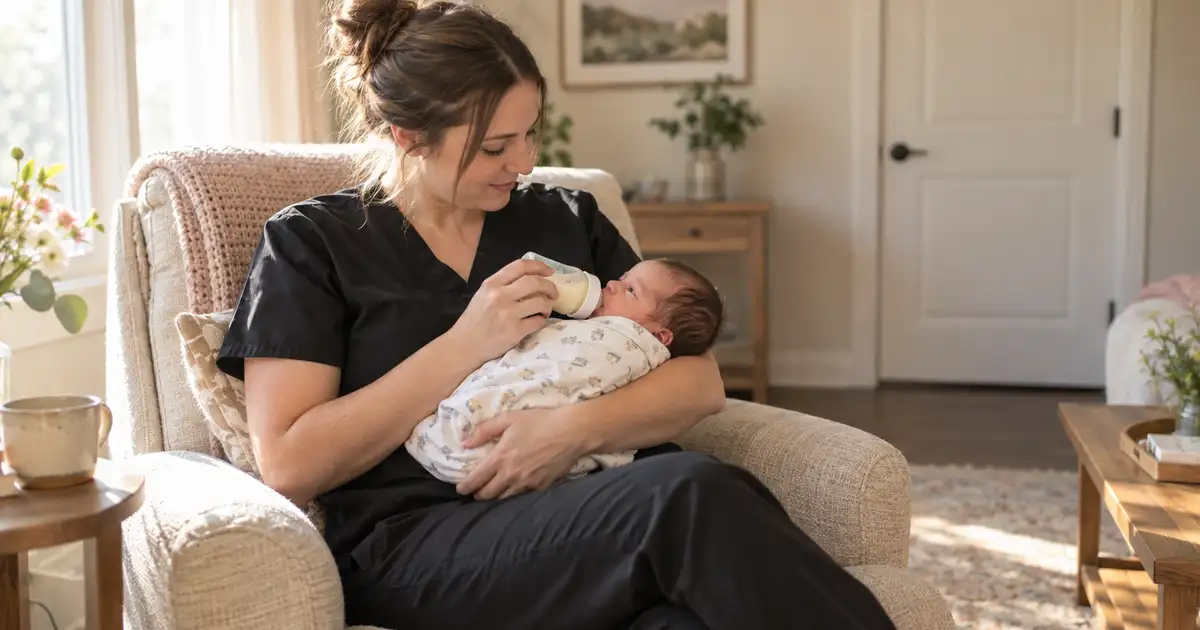
Daytime newborn care is a licensed pediatric RN in your home during waking hours, usually four to eight hours, handling everything the baby needs while you do something else. Most people book it imagining errands. Most of them end up asleep.
That is not a failure of planning. It is the most honest use of the time.
What the hours actually contain
The same work as an overnight shift, moved into daylight. Feeds on your plan, whether that is bottles, expressed milk, or bringing the baby to you. Changes, burping, soothing, settling. Naps in a safe sleep space rather than wherever the baby happened to fall asleep. Bottles and pump parts washed and put back.
At the end you get a written log: when the baby fed and how much, diapers, sleep stretches, and anything worth mentioning to your pediatrician. Not because the day needs auditing, but because by week three nobody can remember Tuesday.
Who it suits better than overnight
There is one question that settles this for most families, and it is not the one people expect.
Can you actually sleep while the sun is up?
Some people can. They hear the door close, go back to bed, and get four real hours. For them daytime care is often better value than an overnight shift, because the sleep lands and the rest of the day still exists.
Other people cannot. The light is wrong, the house is awake, there is a toddler somewhere, and lying down at eleven in the morning just produces an hour of staring at the ceiling. For those families the sleep has to come at night, and daytime care will not fix it.
Neither answer is a character flaw. It is worth knowing which one you are before you book anything.
The other reason people book it
Not sleep. The older one.
A newborn absorbs the entire adult capacity of a house. The four year old who used to have your afternoons now has a parent holding a baby, and they feel it well before they can say it.
Daytime care buys an afternoon where you are not holding a baby. School pickup where you are actually present. A birthday party. An hour on the floor with a toddler who has been waiting two weeks for your full attention.
Families rarely list that as the reason when they enquire. It is very often the reason they rebook.
What it does not cover
Worth being plain, because expectations set badly are their own problem:
- Care for older siblings. The shift is newborn care. Your nurse is there for the baby
- Household cleaning and laundry. Anything belonging to the baby, yes. The family's washing, no
- Cooking for the household
- Pet care and transportation
- Anything medical. Your nurse observes and documents, and tells you when something needs your pediatrician. She does not diagnose and does not prescribe
How families actually combine it
Rarely as a single choice. The common shapes:
Overnight care for the first two or three weeks while the nights are brutal, then daytime shifts once the baby settles and the problem becomes the days.
Daytime shifts on the two days a week that are hardest, usually the ones with appointments or no other adult in the house.
Both in the same week, when a partner goes back to work and the house suddenly has one pair of hands where it had two.
There is no minimum and no package. Tell us which parts of the week are hardest, and we build the schedule around that rather than around a product.
The short version
Four to eight hours where the baby is somebody else's responsibility, in your own house, from a nurse. What you do with it is entirely yours, and sleeping through it is not a waste.
Common questions
What does a daytime newborn nurse actually do?
Everything the baby needs for the length of the shift: feeds, changes, burping, soothing, settling, naps in a safe sleep space, and washing the bottles and pump parts used along the way. You get a written log of feeds, diapers and sleep at the end.
Do I have to leave the house?
No, and most people do not. Plenty of families go back to bed. Others shower without rushing, sit with an older child, or keep an appointment they have moved three times. Staying home asleep is the most common use of the shift.
Is daytime care better than overnight care?
Neither is better. It depends on one thing: whether you can actually sleep while the sun is up. If you can, daytime care may give you back more than overnight would. If you cannot, the sleep has to come at night.
Can the nurse watch my older child too?
No. The shift is newborn care, so your nurse is there for the baby. What daytime care usually gives families is the freedom to be with the older child themselves, which is often the thing that was missing.
How long is a daytime shift?
Typically four to eight hours. Shorter is sometimes possible depending on availability and travel, so it is worth asking rather than assuming.