Bringing Your Preemie Home From the NICU
You have been waiting weeks for this. It is still allowed to be terrifying.
Almost every family I talk to describes the same two things at once: enormous relief, and a low hum of panic that does not go away for a few days. Both are normal, and neither means you are not ready.
Why going home can feel scarier than staying
In the NICU there was always someone. A nurse ten feet away, a monitor interpreting every breath, someone who would notice before you did.
Then you get in a car and drive away from all of it.
What you are feeling is not a lack of confidence in yourself. It is the sudden removal of an entire safety net you had grown used to, all at once, on a Tuesday afternoon. That is a lot, and the fact that it is also the thing you wanted does not cancel it out.
It gets better within days for most families. Not because anything changes, but because you accumulate evidence that you can do this.
What discharge actually depends on
There is no magic weight.
Discharge is about readiness skills: breathing steadily without support, holding their own body temperature in an open crib, feeding by breast or bottle well enough to grow, and gaining weight reliably. Different babies reach those at different sizes and different gestational ages.
Which is why the baby in the next bay went home smaller than yours, or larger, and it did not mean anything about either of them.
Your team also has to be satisfied that you have the plan, the training, the follow-up, and any equipment you need. That part is about your household, not your baby.
Ask about a room-in stay
Many NICUs offer a night or two where you stay in a room at the hospital and do all the care yourself, with help down the hall if you need it.
If yours does and you have not been offered one, ask. It is the single most useful thing available to you before discharge, because it is the real thing with a safety net still attached. Families who do it consistently say the first night at home was easier for having done it.
What to ask before you leave
Discharge day is chaotic and you will not remember what you meant to ask. Write it down beforehand.
The one to get in writing is the feeding plan. How much, how often, whether you are fortifying and for how long, and what to do if a feed goes badly. Everything else you can phone about. That one you will want to read at 3am.
Also worth pinning down before you go: who you call for a question that is not an emergency, who you call at 2am, and when your follow-up appointments are.
The first night without monitors
The silence
This is the part nobody warns you about properly.
For weeks, a machine has been watching your baby and telling you they are fine. Now there is a small person in a bassinet and no numbers anywhere. Plenty of parents sit up watching a chest rise and fall because it is the only monitor left.
That is a completely normal first night. It does ease.
Why your baby is so noisy
Newborns, and preemies especially, are extraordinarily noisy sleepers. Grunting, squeaking, snuffling, sighing, irregular breathing with pauses in it, sudden startles.
In the NICU, a machine interpreted all of that for you. At home there is nothing to check it against, so every sound is a question you cannot answer.
Most of it is normal newborn noise. But your team knows your baby specifically, so ask them before you leave: what should our baby sound like, and what would worry you? That is a much better question than trying to work it out from the internet at 3am, and they will have a real answer for your particular baby.
Should you buy a home monitor?
This comes up with almost every family, and the instinct is completely understandable. You had monitors for weeks and now you have none.
Two things worth knowing.
Consumer monitors are not medical devices. Sock monitors, wearable trackers, and camera systems with breathing detection are not the equipment your baby was on in the NICU, and they are not regulated the same way. They are not a substitute for it.
If your baby was sent home on prescribed medical monitoring, that is different. That is equipment your team chose, and they will train you on it and tell you exactly what to do when it alarms.
For everything else, ask your pediatrician before you buy. Some families find a consumer monitor genuinely reassuring. Others find it makes things considerably worse, because a false alarm at 2am is its own kind of awful. It is worth thinking about which you are likely to be.
What you actually need at home
Less than the internet suggests, and some specific things.
Preemie clothes, which are genuinely a different size and not just small newborn. Depending on your baby you may need them briefly or for a while, so do not buy many.
The bottles and nipples you have been using, if you are bottle feeding. This is not the moment to switch to something new because it was on a list.
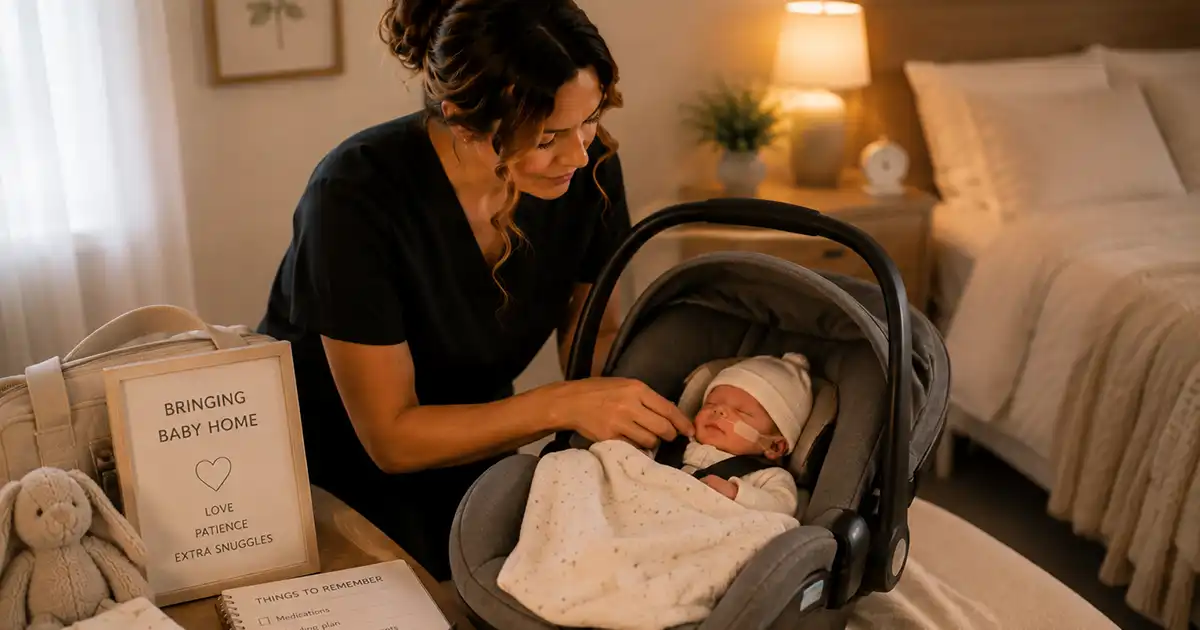
A car seat that fits. Many NICUs do a car seat fit test before discharge, and if yours does, take it. Small babies sit differently, and the angle matters.
Whatever the NICU sends you home with. They will have thought about this.
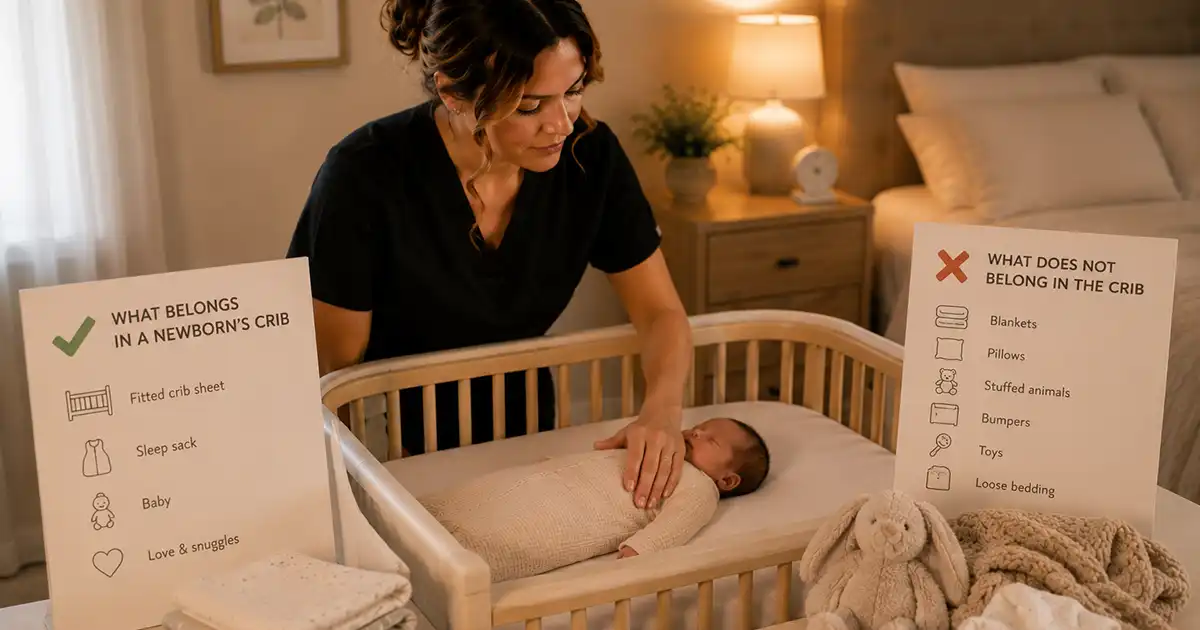
What you do not need is a house full of equipment. The crib stays empty, same as any newborn: firm flat mattress, fitted sheet, nothing else. That is worth saying because NICU babies are sometimes positioned differently in hospital, under monitoring, and parents reasonably assume that carries over. What belongs in a crib covers the rest.
Feeding at home
Follow the plan your team gave you. That is the whole of the advice here, and it is deliberate.
Preemie feeding plans are specific to your baby: volumes, timing, fortification, and how long to persist with a feed before topping up. Those numbers came from people who have been watching your baby grow for weeks, and they are not something to adjust based on an article.
What does help is knowing that feeding often feels harder at home. In the NICU there was a nurse, a schedule, and someone to hand a difficult feed to. At home it is you, at 2am, and a baby who is tired.
If feeds are consistently going badly, if your baby is not waking for them, or if something has changed, that is a call to your team rather than a problem to solve alone.
Do you need to track everything?
Track what your team asked you to track. Usually feeds and diapers, sometimes weight at the clinic.
What I would not do is invent extra monitoring on top of it. Daily home weighing in particular tends to make people miserable, because newborn weight moves around day to day and a scale at home gives you a number without any of the context your pediatrician has.
If your team wants daily weights, they will say so and tell you how.
Visitors, germs, and going out
Your team will give you specific guidance and it takes priority over anything here, because it depends on your baby, the season, and any respiratory history.
Generally, families coming home from the NICU are asked to be more careful for longer than families with a term baby. Handwashing, nobody who is unwell, smaller numbers, and often avoiding crowded indoor places during respiratory illness season.
The hard part is not the rule, it is enforcing it. Saying no to a grandparent with a cough is genuinely difficult after weeks of everyone wanting to meet this baby. It helps to decide the rules with your partner before anyone asks, and to let it be the NICU's rule rather than yours. Our team asked us to wait ends a conversation that we would rather you didn't does not.
A walk outside, away from people, is usually a different question from a grocery store. Ask your team about both.
Corrected age
Your baby has two ages: the one since birth, and the one counted from their due date. The second is corrected age, and it is the one that matters for developmental expectations in the early period.
A baby born ten weeks early is, at four months old, roughly six weeks corrected. Expecting four-month milestones from them is measuring against the wrong thing.
Your pediatrician will use corrected age too. It is worth knowing so that comparisons with other babies, and with charts, do not frighten you unnecessarily. Ask your pediatrician how long they will keep using it, because it stops mattering at some point and that point is different for every baby.
What to watch for, and who to call
Your team will have given you a list specific to your baby. That list wins over anything general.
For anything you are unsure about, call your pediatrician. That is what the first weeks are for, and nobody minds.
Your NICU follow-up clinic handles the developmental and specialist side, and it is worth knowing who your contact there is before you leave.
For breathing difficulty, a blue or gray color, or unresponsiveness, call 911.
Nothing in this article is a reason to change a feeding plan, adjust equipment, or wait on something that worries you.
What help looks like
The first nights are the hardest, and the exhaustion arrives on top of weeks of hospital exhaustion you have not recovered from yet.
Some families have a parent stay. Some have a partner take leave. Some book in-home preemie care, where a pediatric RN with neonatal experience is in the house overnight, working to the discharge plan your team set rather than to a general newborn routine.
Whatever the shape of it, this is not a week to be alone in the house at 3am if you can avoid it. If the nights are the whole problem rather than the days, overnight care from a night nurse is the same idea without the preemie-specific plan attached.
What to remember
- Feeling terrified while also being relieved is the normal version of this
- Discharge is about readiness skills, not a magic weight
- Ask about a room-in stay before you leave
- Get the feeding plan in writing
- Your baby will be noisy. Ask your team what normal sounds like for them
- Consumer monitors are not medical devices. Ask before you buy one
- Follow the feeding plan you were given rather than anything you read
- Corrected age is the one that matters for milestones
- Call your pediatrician. That is what they are there for
Ask before you leave
- What exactly is our feeding plan, in writing?
- Are we fortifying, and for how long?
- What is our follow-up schedule, and who books it?
- Which specialists do we see, and when?
- Do we need any equipment at home, and who trains us on it?
- What medications, at what times, and for how long?
- Who do we call for a question that is not an emergency?
- Who do we call at 2am?
- What would make you want to see our baby again sooner?
- Is a room-in or overnight practice stay available before we go?
- Can we do the car seat fit test before discharge day?
- What should we expect our baby's sleep and noises to be like?
- What are the specific things you want us to watch for?
- Who is our contact at the NICU follow-up clinic?
Ask for the feeding plan in writing. Almost everything else can be phoned about later; that one you will want to read at 3am.
Common questions
When does a preemie come home from the NICU?
Discharge is about readiness skills rather than a magic weight: feeding reliably, maintaining temperature, and stable breathing. Your NICU team sets the criteria and will walk you through where your baby is against them.
What is the hardest part of the first week home?
For most families, the silence where the monitors were. You have wanted this for weeks and it is still allowed to be terrifying. It eases faster than you expect.
Do I need special equipment at home?
That depends entirely on your discharge plan, which is specific to your baby. Whatever your NICU team sends you home with is the plan to follow, and we work to it rather than around it.
Can we get overnight help once we are home?
Yes. In-home preemie and NICU graduate care follows your discharge plan, with a nurse experienced in feeds that take longer, reflux and settling, and watching the things you were told to watch.
Read the video transcript
The thing nobody prepares you for about leaving the NICU is that it can feel scarier than staying.
In the NICU there was always someone. A nurse ten feet away, a monitor watching every breath, somebody who would notice before you did. Then you get in a car and drive away from all of it. That is a lot, and the fact that it is also the thing you have wanted for weeks does not cancel it out.
Two things I would tell every family going home.
First, ask about a room-in stay. A lot of NICUs let you stay a night or two doing all the care yourself, with help down the hall. If yours offers it, take it. It is the real thing with a safety net still attached.
Second, ask your team what your baby should sound like. Preemies are extraordinarily noisy sleepers. Grunting, squeaking, irregular breathing with pauses in it. For weeks a machine interpreted all of that for you, and now there is nothing to check it against. Your team knows your baby specifically, so ask them before you go rather than trying to work it out from the internet at three in the morning.
On monitors, because everybody asks. If your baby was sent home on prescribed medical monitoring, that is different and your team will train you. But consumer sock monitors and camera systems are not medical devices and they are not what your baby was on in the NICU. Some families find them reassuring. Others find a false alarm at 2am makes everything worse. Ask your pediatrician before you buy one.
And get the feeding plan in writing before you leave. Almost everything else you can phone about later. That one you will want to read at three in the morning.