What Belongs in a Newborn's Crib, and What Does Not
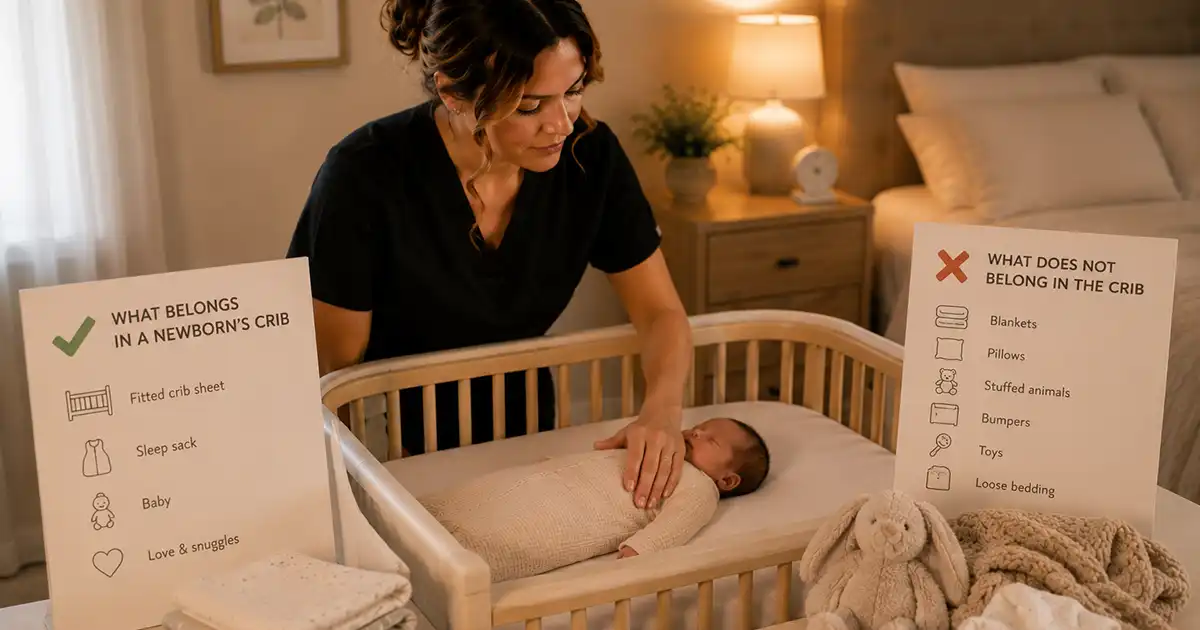
Your baby, a firm flat mattress, and a fitted sheet.
That is the list. It looks bare, it feels like you have forgotten something, and it is correct.
The list is shorter than you expect
A firm, flat mattress that fits the frame with no gap around the edges. Firm enough that it does not indent when your baby lies on it.
A fitted sheet made for that mattress, pulled tight.
Your baby, on their back. Every sleep, every nap, by everyone who puts them down.
That is the whole thing. A newborn can sleep in a crib from birth, incidentally. People often ask whether two weeks is too early, and it is not. The real question behind that one is usually bassinet or crib, which is further down.
What does not go in
Each of these is either unnecessary or a hazard, and most of them arrive as gifts.
Crib bumpers, padded or mesh. They are a suffocation and entrapment risk, and federal law now prohibits their sale in the US.
Pillows, including the small ones sold for cribs.
Nursing pillows. Worth naming separately, because people think of them as different. They are not sleep surfaces, in the crib or anywhere else.
Loose blankets and quilts.
Sleep positioners and wedges, whatever the packaging claims.
Stuffed animals, loveys, and comfort objects. These come later, not now.
Anything with a cord, ribbon, or string, including toys that attach to the rails.
And nothing tucked under the sheet. No folded towel, no extra pad, no mattress topper. It changes the surface your baby is lying on.
The mattress, the sheet, and the protector question
More nuanced than the rest, and people genuinely disagree about it online.
Does the mattress need a protector?
Possibly, and only if it is designed for that mattress and does not change the firmness, fit, or flatness of the surface.
Many crib mattresses already have a waterproof outer layer or a removable washable cover, in which case you need nothing extra. If you do use a protector, it should be thin, fitted, and tight.
What to avoid: thick pads, plush toppers, pillow-top additions, folded towels, and anything that adds softness or creates a gap at the edges.
Can you layer them?
You will see the double-layer trick recommended everywhere: sheet, protector, sheet, so a 3am change is one pull rather than a full remake.
Plenty of families do it. Before you do, check what the mattress and protector manufacturers say, and make sure every layer stays tight and flat with no bunching underneath your baby. If any layer wrinkles or shifts, undo it.
What does not belong under a baby at all: towels, loose waterproof pads, disposable pads, or folded blankets.
How many sheets do you actually need?
Two or three. One on, one clean, one in the wash.
Spit-up and leaks happen more than you expect, and having a spare within reach at 3am is genuinely useful. Store them in the closet or a drawer, though, not stacked in the corner of the crib.
Why no blankets?
Because a newborn cannot move one off their face, and a blanket that shifts over the head is a suffocation risk. They also cannot kick one off if they get too warm.
Which raises the obvious question, and it is the one this article gets asked most.
Keeping a baby warm without one
Too cold, or too warm?
Feel the chest, the back of the neck, or the tummy. Not the hands and feet, which run cool on almost every newborn and tell you very little.
You are looking for warm and dry. Sweating, damp hair, flushed skin, or rapid breathing suggests too warm. Overheating is a genuine concern, and it is the direction most parents err in.
Sleep sacks and what goes underneath
A wearable blanket or sleep sack does the job a blanket used to, without anything loose. Choose the right size so it cannot ride up over the face.
Underneath, roughly what you are wearing plus one thin layer. A onesie and a sleep sack is often enough.
Socks, and the "no-socks rule"
There is no rule. You will see it stated confidently, and it is not guidance from anywhere official.
Cold feet on their own do not mean your baby is cold, because newborn feet run cool regardless. Check the chest instead. If the room is cool and you want socks on, socks are fine. Just do not use them as your thermometer.
Room temperature
Comfortable for a lightly dressed adult. If you are comfortable in the room, your baby probably is too, and that is a more useful test than a number on a monitor.
What about a pacifier?
A pacifier is fine, and many families use one at sleep.
What does not belong is a pacifier with anything attached: a clip, a ribbon, a strap, or a stuffed toy on the end. Those are strangulation and suffocation risks in a sleep space.
If it falls out once your baby is asleep, leave it.
Where the crib goes in the room
The room around the crib matters as much as what is inside it, and this part gets almost no attention.
Away from windows. Blind and curtain cords are a strangulation hazard, and cordless blinds are worth the swap if you have the option.
Away from anything hanging or reachable. Wall art, shelves, mobiles low enough to grab, cords of any kind.
Against a wall is fine, as long as the crib is not near a window and nothing on that wall is within reach.
Not tilted. Propping one end up for reflux or congestion is a common suggestion and it is not a safe one. An inclined surface lets a baby slide down into a position where their chin drops toward their chest. If reflux is the reason you are considering it, that conversation belongs with your pediatrician.
In your room, for the first months. Room sharing, not bed sharing, is what current AAP guidance recommends. A safe sleep and soothing visit goes through this against the room you actually have.
Products sold for the crib that do not match the guidance
Plenty of things marketed for infant sleep are not consistent with safe sleep guidance, and the packaging will not tell you that.
Inclined sleepers. Positioners and nests. Weighted swaddles and weighted sleep sacks. Crib attachments and hammocks. Anything that props, angles, cushions, or restricts movement.
The test is simple: flat, firm, empty, on the back. If a product changes any of those four things, it does not go in the crib.
Monitors are a separate matter. A camera on the wall is fine, and any monitor with a cord needs to be well out of reach. A monitor does not change the sleep space, and consumer devices are not medical monitoring equipment.
Bassinet or crib?
Either, and the rules are the same for both: firm, flat, fitted sheet, empty, on the back.
Bassinets are smaller and easier to keep beside your bed, which is why most families start there. Cribs last longer. Some babies outgrow a bassinet's weight limit or start rolling before you expect, so check the manufacturer's limits rather than guessing.
Whichever you use, the same checks apply to the pack and play, the portable crib, and the setup at your parents' house. If a grandparent or sitter will be putting your baby down, it is worth covering this together so everyone hears the same guidance at once.
A safe crib does not need to look cozy
Worth saying plainly, because this is the part nobody prepares you for.
Every nursery photo you have seen has a quilt folded over the rail, a bumper, a knitted blanket and three soft toys arranged in the corner. Then you set yours up correctly, look at it, and it feels cold. Unfinished. Like you have not done enough for your baby.
You have. The bare crib is the finished version.
If you are frightened about SIDS, and a great many parents are, that fear is normal and it does not mean anything is wrong with you. What helps is knowing that the sleep space is the part you control, and once it is right, it is right. You have done the thing that was yours to do. You are allowed to stop re-reading articles at midnight, this one included.
Put the soft things in a basket, on a shelf, in a photograph. Just not in the crib.
What to remember
- Baby, firm flat mattress, fitted sheet. Nothing else
- Bumpers, pillows, nursing pillows, blankets, positioners and toys all stay out
- Nothing under the sheet that changes how firm or flat the surface is
- Check the chest, not the hands and feet, and dress for the room
- There is no "no-socks rule", and cold feet are not a thermometer
- Crib away from windows and cords, and never tilted
- The same rules apply to the bassinet, the pack and play, and grandparents' house
- An empty crib is the correct one
Check every sleep space, not just the nursery
- Firm, flat mattress that fits the frame with no gaps at the edges
- A fitted sheet made for that mattress, pulled tight
- Nothing else inside: no bumpers, pillows, blankets, or toys
- Baby placed on their back, every sleep, by everyone
- Crib away from windows, blind cords, and cords of any kind
- Nothing hanging within reach of the crib
- Crib not tilted, propped, or wedged at an angle
- Room temperature comfortable for a lightly dressed adult
- Sleep sack or wearable blanket instead of loose bedding
- The same checks done in the bassinet, the pack and play, and at grandparents
- Nothing added to the mattress that changes how firm or flat it is
- Spare sheets stored in the closet, not stacked in the crib
The last two catch people out. A folded towel under the sheet and a stack of spare bedding in the corner of the crib both feel harmless and neither is.
Common questions
What should be in a newborn's crib?
Your baby, a firm flat mattress, and a fitted sheet. That is the whole list. An empty crib looks wrong to almost every new parent, and it is not wrong.
Are bumpers, pillows or loose blankets safe in a crib?
No. Bumpers, pillows, loose blankets, positioners and stuffed toys all belong outside the sleep space. Follow current safe sleep guidance and your pediatrician's advice.
How do I keep my baby warm without a blanket?
Dress for the room rather than the weather, and use a sleep sack instead of a blanket. One more layer than you would wear comfortably in the same room is the usual guide.
Does where the crib sits in the room matter?
Yes, often more than what is inside it. Away from cords, blinds, heaters and anything that can be reached from the crib. A safe sleep visit works through the room you actually have rather than an ideal one.
Read the video transcript
People ask what goes in a newborn's crib, and the answer is shorter than anyone expects. Your baby, a firm flat mattress, and a fitted sheet. That is it.
What stays out is bumpers, pillows, blankets, positioners, stuffed animals, anything with a cord, and anything tucked under the sheet. No folded towel, no extra pad. It changes the surface your baby is lying on.
The question I get straight after that is always about warmth. If there is no blanket, how do I keep them warm?
Use a sleep sack, and dress them in roughly what you are wearing plus one thin layer. And when you are checking whether they are warm enough, feel the chest or the back of the neck. Not the hands and feet. Newborn feet run cool no matter what, and people put an extra layer on a baby who was already warm enough because the feet felt cold.
There is also no such thing as the no-socks rule. You will see it stated very confidently online. If the room is cool and you want socks on, that is fine. Just do not use the feet as your thermometer.
One more thing about the room itself. Keep the crib away from windows and blind cords, and do not tilt it. Propping one end up for reflux gets suggested a lot and it is not safe, because a baby can slide down into a position where the chin drops toward the chest.
And the last thing, which is the one I actually care about most. A safe crib does not look like the nursery photos. It looks bare. That is the finished version, not the unfinished one. Put the soft things in a basket.