My Newborn Only Sleeps When Held. What Should I Do?

This is normal. Your baby is not doing something wrong, and neither are you.
The problem worth solving is not really your baby's sleep. It is yours, because an exhausted parent holding a baby at 4am is the genuinely risky part of this situation.
Yes, this is normal
Newborn sleep is irregular by design. Regular sleep cycles do not develop until somewhere around four months, and before that a newborn may sleep in stretches of one to two hours at a time, day or night.
They have also just spent nine months somewhere warm, constantly held, and full of the sound of your body. A firm flat surface in a quiet room is not an obvious upgrade from where they were.
Preferring to be held is not a habit you accidentally created in week one. It is the starting position.
"Drowsy but awake" is not newborn advice
This one causes a lot of unnecessary guilt, so it is worth being clear.
The advice to put a baby down drowsy but awake, so they learn to fall asleep independently, is generally framed for babies around four months and older. It is not a standard for a two-week-old.
If you have been trying it with a newborn and failing, you have been measuring yourself against a milestone that does not apply yet. You can stop.
Why they wake the second you put them down
Several things happen at once when you make the transfer.
The temperature changes. You are warm. The mattress is not.
The position changes. Curled against a body, then suddenly flat.
Their arms move, which sets off the startle reflex, which wakes them.
And they may not have been deeply asleep yet. Newborns spend a lot of time in light sleep, and light sleep is easy to interrupt.
None of that is you doing it wrong. It is a fairly demanding physical transfer performed by someone who has not slept.
Making the transfer work
Wait longer than you think. Fully limp arms, slack jaw, no reaction when you shift slightly. Rushing this is the most common reason it fails.
Feet and bottom first, head last. Lower the lower half, then the shoulders, then the head. Keep them tucked and close to you as long as possible.
Keep a hand on the chest for a moment after you let go, then lift it slowly. The gradual removal of pressure is often what makes the difference.
Warm the surface first, carefully. A heat pad or warm water bottle on the mattress for a few minutes, removed before your baby goes down, takes the cold-sheet shock out of it. Nothing warm stays in the sleep space.
Swaddle, if it helps and your baby is not showing any signs of rolling. When to stop swaddling covers where that line is.
White noise, if it helps. Quiet, away from the crib, not against the ear.
And practice this in the daytime. Trying to solve it at 3am, on no sleep, after four failed attempts, is the worst possible conditions. Daytime naps are where the learning happens.
The real safety issue is you
Here is the part I most want you to read.
The danger in this situation is not that your baby is being held. It is that a parent who has been awake for twenty hours will eventually lose the fight to stay awake, while holding a baby, on a couch or a recliner or in bed.
Couches, armchairs, and recliners are the most dangerous places to fall asleep with a baby. Considerably more so than an adult bed, and far more than the bassinet you have been trying to avoid.
So the rule for the bad nights is this: if you are fighting to stay awake while holding your baby, put them down. In the bassinet, on their back, even if they are awake, even if they cry. A crying baby in a safe sleep space is safer than a sleeping baby in your arms while you are going under.
That is not a failure. It is the correct call, and it is the one thing on this page I would want you to remember at 4am.
Getting actual sleep
Shifts. If there are two of you, one takes the first stretch and one takes the second, and the off-duty parent sleeps somewhere they will not be disturbed. Four unbroken hours is worth considerably more than eight broken ones.
If you are breastfeeding, you still wake for feeds, but you do not have to be the one doing the settling, changing and re-transferring afterward. That is the part that can be handed over, and it is most of the time.
Contact naps in daylight are fine, with a caveat that matters: the person holding the baby has to be awake. Sitting up, on a couch, with a partner around and the intention of "just resting your eyes" is exactly how the unsafe version happens.
If you want to nap while your baby naps, your baby goes in the bassinet.
What not to do when you are desperate
These all come up, and all of them make things worse.
Do not put a newborn on their stomach because they sleep better that way. They usually do. That is not the deciding factor.
Do not use a lounger, swing, bouncer, or car seat for routine sleep. They are not sleep surfaces. If your baby falls asleep in one, move them.
Do not tilt or prop the crib. For reflux or anything else. If reflux is what you are working around, that is a pediatrician conversation.
Do not bring them into an adult bed as an unplanned 4am decision. If bed sharing is something you are considering deliberately, that is a conversation to have with your pediatrician while you are rested, not a choice made at the point of collapse.
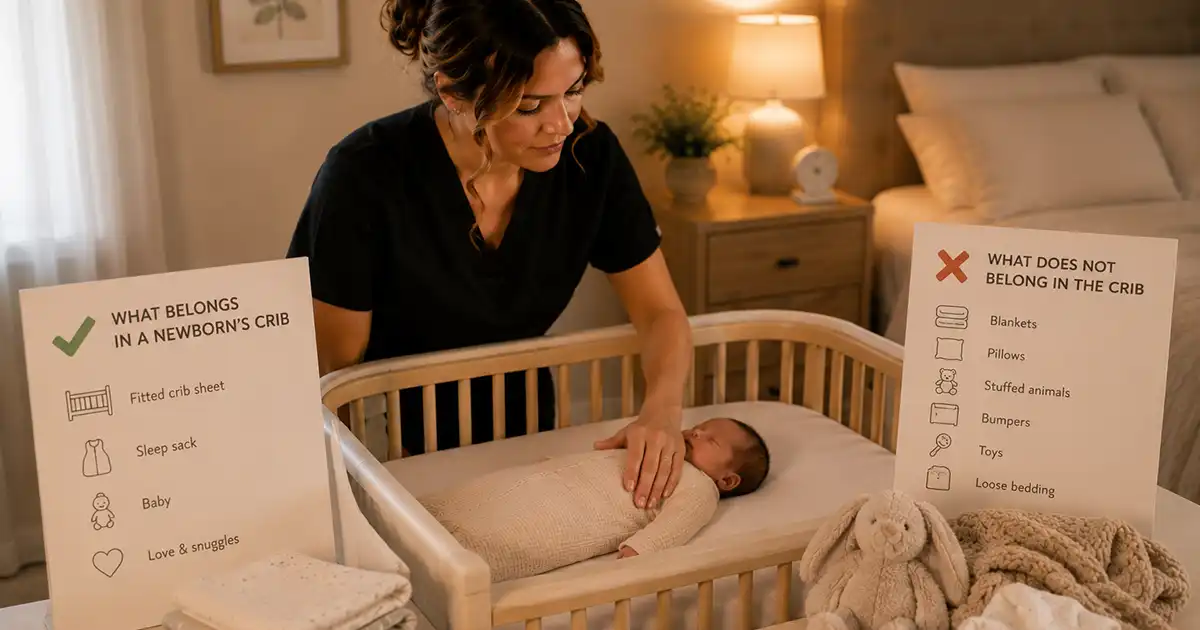
And nothing goes in the crib to make it more comforting. What belongs in a crib is a very short list.
When it is not just contact-seeking
Most of the time this is normal newborn behavior. Sometimes it is worth a call.
Call your pediatrician if your baby seems inconsolable rather than simply unsettled, if feeding has changed, if there are fewer wet diapers than you expect, if they seem in pain when laid flat, if they are unusually sleepy or hard to wake, or if you are worried about weight.
Being hard to settle is common. Being difficult to rouse is not, and that is the one to call about promptly.
And call about yourself too. If you have not slept properly in days, if you feel unable to cope, or if you are frightened by how you feel, that is a medical concern and it is treatable. Tell your OB, your midwife, or your own doctor. Postpartum Support International can connect you with local support at 1-800-944-4773. If you are in crisis, call or text 988.
When nobody in the house is sleeping
At some point this stops being a settling problem and becomes a sleep deprivation problem, and those need different answers.
If there are two of you, shifts. If family can take a night, let them. And if neither is available, a night nurse in Birmingham exists for exactly this: someone awake in the house, working on the transfers, while you sleep through it. Some families book one night to break the cycle and find that is enough.
What I would not do is keep going indefinitely on the assumption that it will resolve on its own next week. It usually does improve. But you do not have to prove anything by getting there unassisted.
What to remember
- Contact sleeping is normal, and it is the starting position rather than a habit you created
- "Drowsy but awake" is guidance for older babies, not newborns
- Wait for fully limp before transferring. Feet first, hand on the chest
- Practise transfers in daylight, not at 3am
- Falling asleep holding a baby on a couch or recliner is the real danger
- If you are fighting sleep while holding them, put them down. Even crying
- Contact naps are fine when the person holding is awake
- Hard to settle is common. Hard to wake is a call
A plan for the next few days
- Practice bassinet sleep during the DAY, when you are awake and less desperate
- Wait until your baby is fully limp and deeply asleep before transferring
- Lower them feet and bottom first, head last
- Keep a hand on the chest for a moment after letting go
- Warm the surface with a heat pad, removed before your baby goes down
- Swaddle if it helps and your baby is not yet rolling
- White noise if it helps, quiet and away from the crib
- Take the first stretch of night in shifts, if there are two of you
- If you are fighting sleep while holding your baby, put them down
- Never on a couch, recliner, armchair, or adult bed
- Contact naps in daylight, with someone awake, are fine
- Call your pediatrician if feeding changes or your baby is hard to wake
The ninth one is the whole article. Putting a crying baby down in a safe space is safer than holding them while you lose the fight to stay awake.
Common questions
Why will my newborn only sleep when held?
Because it is normal for a newborn rather than a habit you created. Being held is warm, close, and exactly what a newborn is built to expect. Most babies move past it, and doing it in the early weeks does not make it permanent.
Is contact napping bad for my baby?
Contact napping while you are awake and alert is normal and not something to feel guilty about. The risk is not the holding. It is falling asleep holding your baby on a sofa or armchair, which is far more dangerous than a bassinet.
How do I get my newborn to sleep in the bassinet?
Work on transfers in the daytime when you are less exhausted, and protect your own sleep at night rather than fighting the transfer at 3 a.m. Warming the surface, waiting for a deeper sleep before moving, and going down feet first all help some babies.
Should I use the drowsy but awake method with a newborn?
It is advice that suits older babies far better than newborns. A newborn who is drowsy is usually on the way to asleep, and expecting them to finish the job alone sets most families up to feel like they are failing at something developmentally early.
Read the video transcript
If your newborn will only sleep when held, the first thing to know is that this is normal. It is not a habit you created in week one. Your baby spent nine months warm and held and full of the sound of your body, and a flat mattress in a quiet room is not an obvious upgrade.
The second thing, and this is the one nobody tells you: drowsy but awake is advice for babies around four months and up. It is not a standard for a two-week-old. If you have been trying it and failing, you have been measuring yourself against something that does not apply to you yet.
For the transfer itself, wait longer than you think. Fully limp arms, slack jaw. Then go feet and bottom first, head last, and keep a hand on the chest for a moment after you let go. And practice this during the day, not at three in the morning after four failed attempts.
But here is the part I actually care about.
The dangerous thing in this situation is not that your baby is being held. It is that a parent who has been awake for twenty hours will eventually lose the fight to stay awake while holding them. And couches and recliners are the most dangerous places for that to happen. More dangerous than the bassinet you have been trying to get them into.
So if you are fighting to stay awake while holding your baby, put them down. Bassinet, on their back, even if they are awake, even if they cry. That is not giving up. That is the correct call, and it is the one thing I would want you to remember at four in the morning.
And if nobody in your house has slept in days, that has stopped being a settling problem. Take shifts, call in family, or get someone in. You do not have to prove anything by getting through this unassisted.